
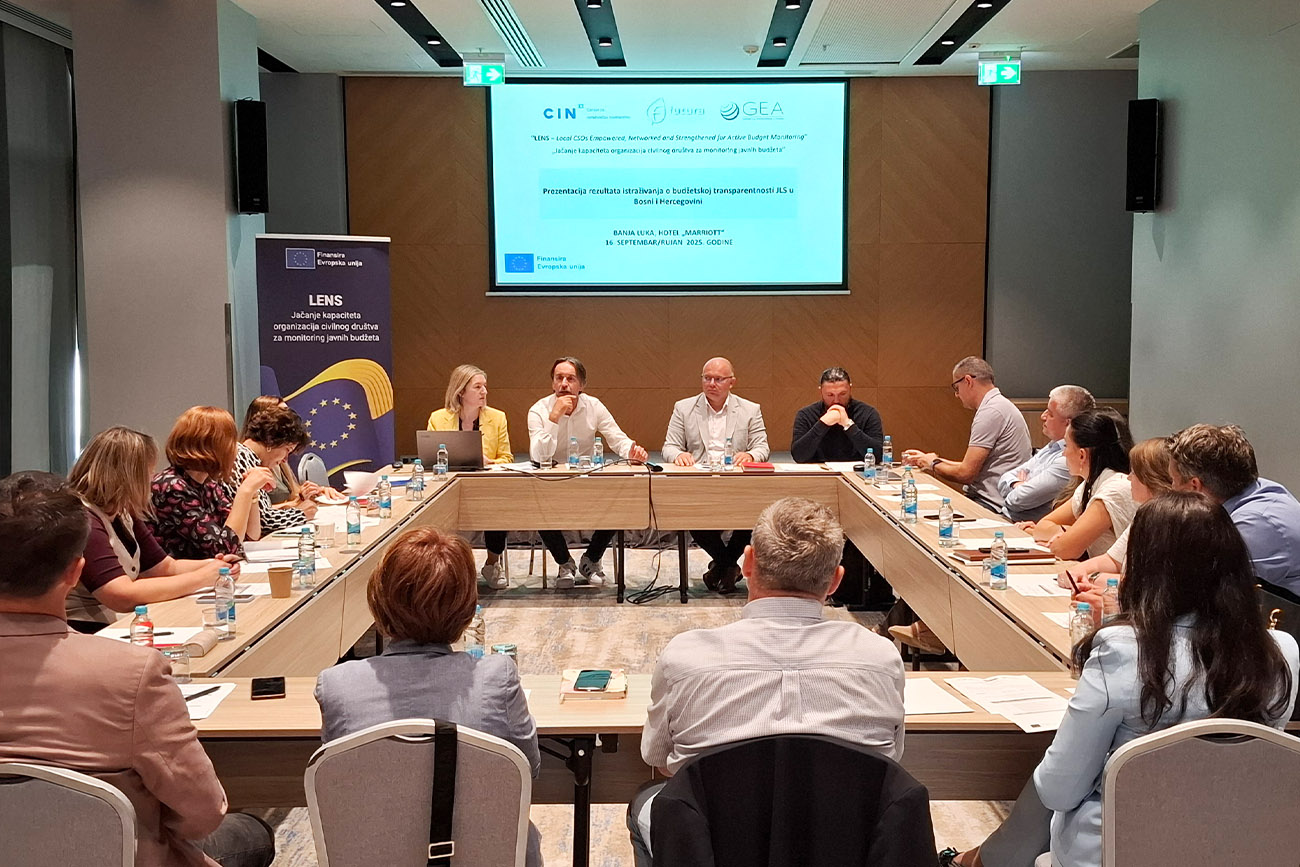
The results of a research on budget transparency conducted by the Center for Research and Studies – GEA from Banja Luka, which for the first time included all local government units in Bosnia and Herzegovina, show a low level of transparency of local governments in our country.
By: Center for Investigative Reporting (CIN)
In local governments in Bosnia and Herzegovina (BiH), budget transparency is not at a satisfactory level and it is necessary to work on improving it, according to the results of a survey on budget transparency in local government units in BiH conducted by the Center for Research and Studies – GEA from Banja Luka.
“Budget transparency at the local level is of key importance because it enables more efficient, responsible and inclusive management of public funds. Unfortunately, the results of the survey show that the level of budget transparency of local government units in Bosnia and Herzegovina is at a low level,” said Vladislav Jakovljević from the Center for Research and Studies – GEA.
Jakovljević adds that it is necessary to more actively involve civil society representatives, the media and other stakeholders in the budget processes in order to ensure a sufficiently high level of information about the budget processes.
| The average number of points recorded during the survey for all observed local government units was 32.81 out of a maximum of 75 points, which is significantly below 50% on the success scale. Also, when considering that the results of the global survey on budget openness in BiH for 2023 had an index of only 28, it is evident that the level of public awareness of budget processes is low. |
A comprehensive survey on budget transparency was presented at this event, which for the first time includes all local government units in our country. During the round table, the cities of Bihać and Gradiška presented their good practices in creating conditions for achieving a high level of transparency in spending public funds.
MANUAL FOR CSOs – Step by Step: From Research to Implementation of a Local Initiative
Jasmina Ćoralić, Assistant Mayor for Finance and Economy, said that the City of Bihać is an example of good practice in BiH.
“A system for monitoring budget execution has been established, preparation of budget execution reports on a monthly basis – for users, regular reporting on budget execution and spending of budget reserves at City Council sessions, which enables efficient control of spending of funds − active involvement of citizens through public discussions, advice and online platforms for participation in creating and monitoring the budget,” says Ćoralić.
Her colleague from Gradiška, Darko Vrhovac, Head of the Department for Development and International Projects, says that his city has a financial module application from document input to output, where everything is digitalized, and it is related to the budget, contracts, fixed assets, incoming and outgoing invoices.
“We have asset databases, documentation databases, multiple databases containing information on assets, a DMS administration system, without paper, we can open everything from the system in open data. E-government, or submitting requests electronically, is in the implementation phase. Acts and decisions made by the Assembly and the Mayor are in the database, as well as other databases of businessmen, farmers and the like,” said Vrhovac.
The roundtable also presented data on the challenges of achieving budget transparency in a small local community. Bojan Ćulibrk, independent expert associate for general and administrative affairs, economy and entrepreneurship, public procurement and human resources of the Municipality of Petrovac-Drinić, says that in smaller local communities, the implementation of the principle of budget transparency is faced with a number of obstacles.
“Limited administrative capacities, technical and infrastructural limitations, weak culture of citizen participation, political influences, perception that transparency is not a priority. In order to overcome these challenges, it is necessary to invest in the capacities of local administration, develop digital tools, for example simple budget portals, raise citizen awareness and introduce an obligation to introduce key budget documents in a simple, easy-to-understand format”, explains Ćulibrk.
The aim of the project LENS – Strengthening the capacities of civil society organizations for monitoring public budgets is to contribute to the fight against corruption by raising the level of monitoring of budget spending and the use of public funds at the local level, with the active participation of civil society.