
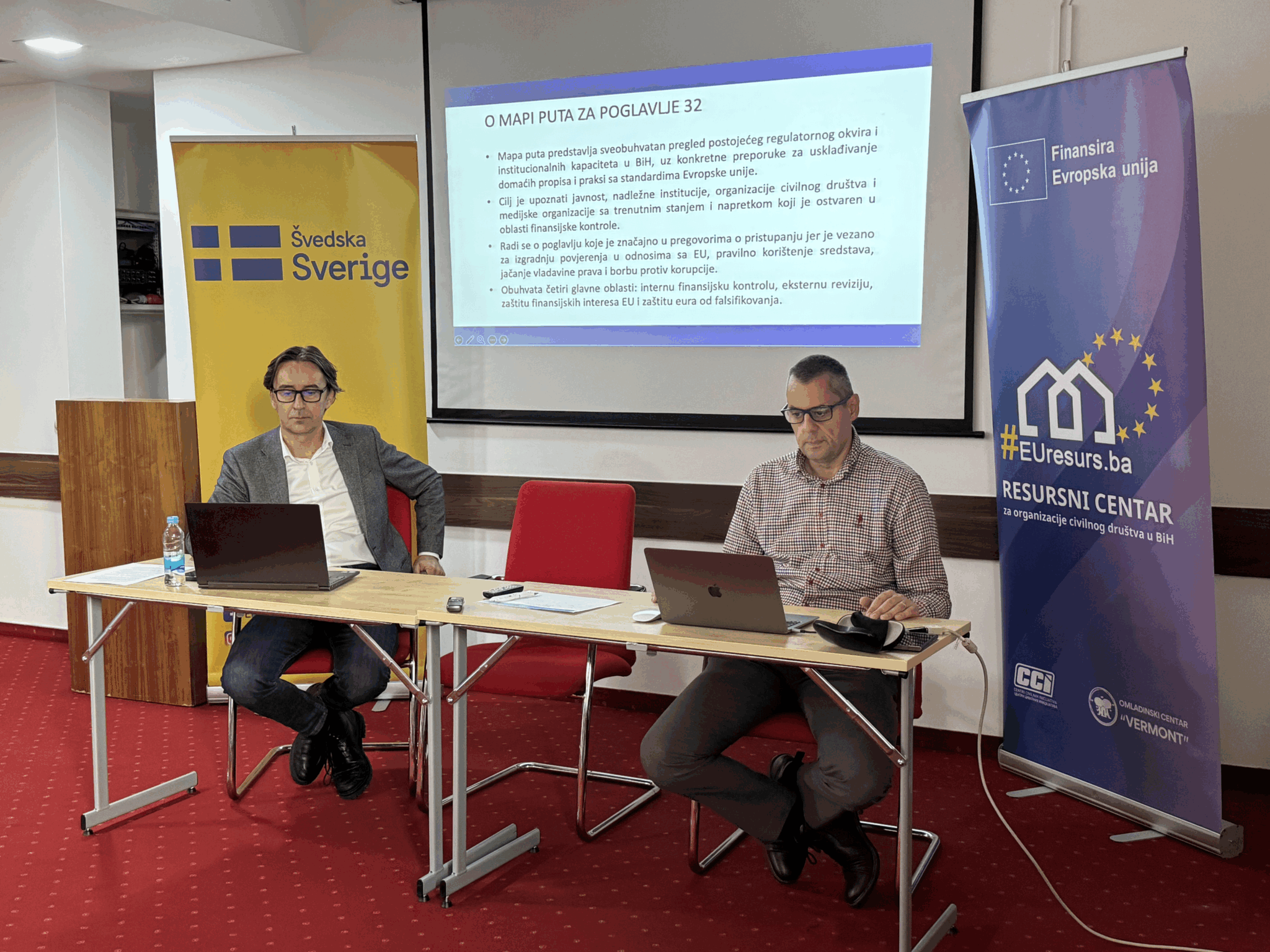
The Resource Centre for Civil Society Organisations in Bosnia and Herzegovina and the Center for Research and Studies (GEA) presented the “Roadmap for Chapter 32 – Financial Control”.
This document provides a comprehensive overview of Bosnia and Herzegovina’s alignment with European Union requirements and standards in the areas of public financial management, external audit, and the protection of the EU’s financial interests.
Chapter 32 is one of the most important chapters in the EU accession process, as it covers the establishment of efficient and transparent financial management and control mechanisms, independent external audit, and the protection of the euro against counterfeiting and other forms of financial fraud. This area is crucial for strengthening the rule of law, ensuring responsible management of public funds, and combating corruption.
The analysis shows that Bosnia and Herzegovina has made some progress in establishing a legislative framework for public internal financial control and internal audit. However, the system is still characterised by a fragmented institutional structure, limited delegation of responsibilities, a lack of coordination between different levels of government, and incomplete implementation of legislation.
The document highlights the need to harmonise the legal framework and public financial management standards across all levels of government, strengthen internal audit capacities, ensure full independence of supreme audit institutions, and establish a functional system for protecting the EU’s financial interests and safeguarding the euro against counterfeiting.
“Chapter 32 is of key importance because it directly affects citizens’ trust in institutions and the state’s ability to manage public funds in a transparent and accountable manner. As the analysis shows, we have a solid legal framework and alignment with international standards, but we lack real implementation in practice, coordination between levels of government, and independence of audit institutions. Our task is to systematically bridge the gap between what is written and what is applied in practice,” stated Marko Martić, Center for Research and Studies GEA.
Through the “Roadmap,” concrete recommendations are also proposed in the form of an Action Plan, which elaborates key tasks and measurable activities that the competent institutions in Bosnia and Herzegovina need to implement over the next five-year period in order to successfully conclude negotiations under Chapter 32.
GEA representatives particularly emphasised that establishing a strong, independent, and professional financial control system is essential for building trust between Bosnia and Herzegovina and the European Union. “This is the foundation of transparent and accountable management of public funds,” GEA representatives noted.
“The Financial Management and Control (FMC) system is the core mechanism that enables institutions to properly plan, assess risks, and make responsible financial decisions. Data show that as many as 50% of institutions and public enterprises do not apply the FMC system in the manner prescribed. The key challenge is the lack of accountability of decision-makers and the absence of sanctioning mechanisms that would ensure the application of FMC in practice. Without clear deadlines and precise sanctions for failing to establish a financial control system, real results cannot be achieved. FMC must be an obligation—not a recommendation—and it must be linked to objectives, risks, and responsibilities within every institution,” stated Vladislav Jakovljević, Center for Research and Studies GEA.